
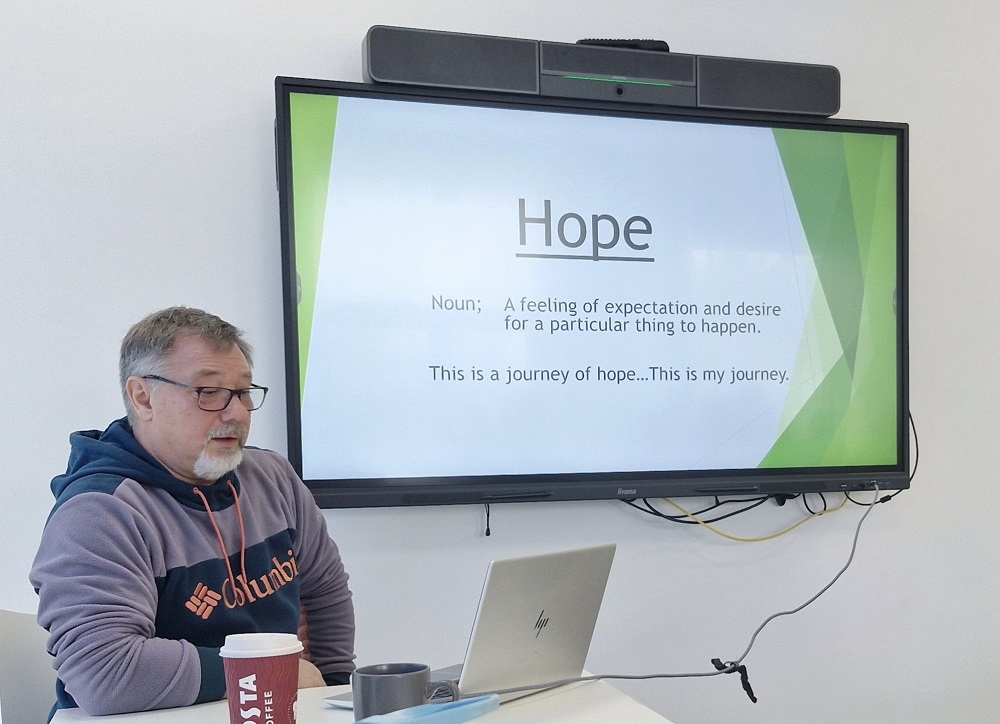
Michael Legg may not realise it, but he is a true inspiration to us all at Headway Essex—especially to the people who benefit from our services and have the chance to hear him speak.
Michael is a Peer Support Volunteer at our centre in Colchester. He has a brain injury himself and volunteers his time to talk to others about his experiences and to help them build a better understanding of the changes their injury has brought to their lives. He is also an ambassador, presenting to groups and organisations to raise awareness of acquired brain injury (ABI).
Michael’s story
Michael is a wonderful representative for Headway Essex, delivering his presentations to brain injury support groups, university students, and at information sharing events. Through these sessions, he helps raise awareness about brain injury by openly and candidly sharing his personal story—how his life changed 16 years ago after a violent attack.
While Michael’s story is difficult to hear, it’s an important one that highlights strength, resilience, and the power of hope. The attack caused serious injuries, including multiple brain traumas, but Michael faced his long journey of healing with determination. During his time in hospital, he received support from therapists and the neurorehabilitation team in Andover, where he was living at the time. Their care played a vital role in his progress and ongoing recovery.
During his therapy sessions Michael underwent regression therapy, a form of hypnotherapy and psychoanalysis, which helps individuals explore and make sense of past experiences, or traumas. This approach was especially helpful for Michael, who had no memory of the events of his attack. and the regression therapy was used to help him to remember what had happened to him so he could testify in a criminal case relating to the attack. Through the therapy, he worked toward recovering those memories, enabling him to contribute important testimony in a criminal case related to the incident. While revisiting difficult experiences can bring up intense emotions, doing so in a safe, therapeutic environment allowed Michael to begin processing his trauma.
The return to work
After a period of time Michael felt he was able to return to work. His employers valued him and were very understanding, supporting his return. Unfortunately the company went into liquidation soon after and closed six months later. Although Michael was finding it very difficult to manage his work responsibilities, his employers made it possible for him to remain employed long enough to qualify for redundancy.
Losing his job marked the end of a chapter and the realisation that he was no longer able to work, and unable to find someone who would employ him, left him feeling useless. It made him realise that he wasn’t going to return to the life he had before his injury and that it had changed him. The transition was emotionally hard and left him feeling suicidal.
Finding Headway
Michael has faced many challenges and his life has taken different turns as he navigated his life after a brain injury. He has gone through relationship break down, job loss and a sense of loss of self. He acknowledges that this was a deeply challenging period of adjustment, marked by feelings of anger, and the effects of the injury to his brain including difficulty sleeping, fatigue, and cognitive problems.
Three years ago, he relocated to Essex, a move that brought new challenges. As he adjusted to life without the support network of his close family and friends his depression spiralled.
After a chance conversation with an advisor at the Job Centre who had experience of a brain injury he was recommended to approach Headway Essex.
Michael came to the Headway Centre and later joined the Next Steps project at Essex University where people with a brain injury work with Headway Essex and Occupational Therapy Students from the University to learn from each other. The sessions are tailored to each individual, making them highly meaningful. In turn, the healthcare students gain practical experience and insight into acquired brain injury, enriching their future practice.
Finding purpose in giving back
During these sessions we suggested that Michael join our team of volunteers as a Peer Support Volunteer so he could share his valuable knowledge and his positivity.
Michael joins in our support groups and will sit and share his story or listen to the group’s. Michael brings valuable insight and compassion to our support groups. As someone with lived experience of brain injury, he understands how important it is to have a space where you can be yourself—free from judgment, pressure, or the need to “mask” your struggles. He knows the relief that comes from being among people who can relate to the challenges they are going through.
He is thankful for the support he has received through therapy and counselling and appreciates how it has helped him through his recovery and wants to give back.
For Michael volunteering is a two-way street. Through giving back in this way, Michael in turn gains a lot. He finds real joy in seeing others regain a sense of hope and self. Through his journey, he’s learned that acknowledgment and acceptance are vital steps in healing. It’s not easy to come to terms with the things you can no longer do, but by openly sharing his challenges and growth, Michael shows others that acceptance is not the end—it’s the beginning of a new path forward.
We are ever grateful to all of our volunteers for their dedication, kindness and the time that they give. Without their help we wouldn’t be able to achieve all that we do.
Thank you to each and every one of you.
If you are intetested in volunteer roles at Headway Essex you can find out more here : https://www.headwayessex.org.uk/i-want-to-help-2/volunteer/
